Sunday, March 2, 2008

Human Eye Paper

The eye is a very interesting and complex organ within the human body. Its main function is to provide sight.

The outermost layer of the eye is called the sclera and it maintains the shape of the eye. The front clear part of this is called the cornea. Extraocular muscles are the muscles that move the eye and these are attached to the sclera. All light must pass through the cornea first and then moves onto the choroid which is the second layer of the eye. This part contains blood vessels that supply blood to the different parts of the eye and contains two structures called the iris and ciliary body. Within the iris there are two muscles the sphincter and dilator. The dilator muscle makes the iris smaller and pupil larger which allows more light into the eye. The sphincter muscle makes the iris larger and pupil smaller which allows less light into the eye. Pupil size can change from 2 millimeters to 8 millimeters on average and when the size of the pupil changes, it changes the amount of light that enters the eye 30 times. The innermost layer of the eye is called the retina and this is the light-sensing portion of the eye. Contained in this layer are rod cells, which are responsible for vision in low light, and cone cells that are responsible for color vision and detail. The macula is located in the back part of the eye in the center of the retina. In the center of the macula is the fovea centralis and this part contains only cones as it is used for seeing fine details. The retina also contains a chemical called rhodopsin, known as "visual purple." This chemical converts light into electrical impulses that the brain then measures as vision. Retinal nerve fibers are connected at the back of the eye, forming the optic nerve, which sends the electrical impulses to the brain. The optic disk is where the optic nerve and blood vessels exit the retina. This is a blind spot on the retina because there are no rods or cones. Yet we are unaware of this blind spot because each eye covers the blind spot of the other eye. This is some of the basic anatomy of the human eye. (Bianco, M.D. 2)

There are many infections, diseases, etc. that cause vision problems or even blindness. Glaucoma is when drainage of an aqueous humor which is produced in the ciliary body and then drained through the canal of schlemm is blocked. The conjunctiva, which keeps the eye moist, can have an infection called conjunctivitis also known as pink eye. The eye is protected from injuries by a bony cavity called the orbital cavity and eyelids do this by blinking. Eyelashes and eyebrows also protect the eye from particles that may harm it. Nearsightedness, also known as myopia, is when a person is able to see near objects well but has difficulty seeing objects that are farther away. Farsightedness, also known as hyperopia, is when a person is able to see distant objects well but has difficulty seeing objects that are closer. Astigmatism is an uneven curvature of the cornea that causes distortion in vision. The older we get the more the lens becomes less elastic and loses its ability to change shape. This is called presbyopia. It is more noticeable when we try to see things up close, because the ciliary body must contract to make the lens thicker and the loss of elasticity prevents the lens from becoming thicker. This causes us to lose our ability to focus on certain objects. A cataract is cloudiness in the lens that blocks light from reaching the retina and can be corrected with surgery. Trachoma is an infection caused by an organism called Chlamydia trachomatis and is disease is the most common cause of blindness is the world, however is rare in the United States. Other causes for blindness include vitamin A deficiency, tumors, strokes, neurological diseases, other infections, and hereditary diseases. (Bianco, M.D. 9, 10, 12)

The eye relies on refraction in order to focus on various objects. Refraction takes place by the aqueous humor, which is a liquid on top of the lens. Light is refracted as it comes into the eye by the liquid, is then refracted more by the lens, and then more by the vitreous humor, which is a jelly-like substance located in the space between the lens and the retina. The lens is critical in creating a sharp image so it can adjust quickly when focusing objects at different distances and this process is known as accommodation. (Polarization 1)

The eye is a very interesting and vital organ in the human body. It works to help us focus in on images at various distances. By this we are able to observe the world around us and enjoy its beauty.

Works Cited

Bianco, M.D., Carl. ""How Vision Works"." How Stuff Works. 1998. 2 Mar 2008 http://health.howstuffworks.com/eye4.htm

unknown, unknown. "Polarization; and the Human Eye." University. 2 Mar 2008 http://physics.bu.edu/~duffy/PY106/Eye.html

Sunday, February 24, 2008

The Electromagnetic Spectrum by Austin

The Electromagnetic Spectrum

Electromagnetic waves occur when there is a disturbance in the electric force field, which is made up of charged particles like electrons and protons. Different kinds of waves are determined by how long their wavelengths are. A wavelength can be determined by how many times a wave completes its cycle over a set period of time. The shorter the wavelength, the more powerful the wave is and the more energy it has.

Starflower

The longest wavelengths, like TV and radio waves can be about 20 meters or longer. They are used to transport information without using wires, and can even go through space. They work by sending electric currents through conductors called antennae which send and receive the wave impulses. These radio waves can communicate with submarines under water, create the radio we can listen to, and communicate into outer space.

There are also microwaves, which are between a millimeter and a meter long. We all think of the microwave ovens we use in the kitchen, but this is only one of their uses. They care also used in radar that can detect the range and speed of things. They are also useful for GPS and navigation systems.

Infrared waves are about 0.00001 meters. Infrared means “below red” in latin, because they are directly below visible light on the electromagnetic spectrum. They can be used for surveillance, night vision, tracking, wireless communication, and they are used extensively in weather forecasting.

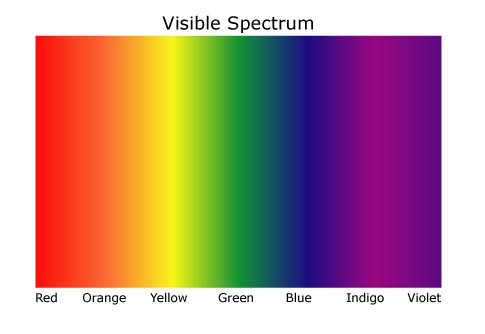
Visible light is about 0.0000006 meters long in wavelength. The colors we see also have a spectrum of their own: red, orange, yellow, green, blue, indigo, violet. They also go in order of wavelength, with red being the longest and violet having the shortest length.


Starflower


Ultraviolet, or UV rays are about 0.00000003 meters, and are usually associated with exposure to the sun. They can cause cancer, blisters, or scars if exposed too long. They are used in medicine for killing bacteria and viruses and sterilize equipment. They are also used to make blacklights, and experiments show that birds and insects can see UV light.

X-rays which are about 0.0000000009 meters, are used in medicine to photograph the bones and internal organs of a patient. And the highest energy waves are gamma which are produced through high energy protons or radioactive decay. They are so powerful that it takes large mass objects to absorb their energy. They can easily cause damage to living tissue, and are the most dangerous in a nuclear explosion.

Wednesday, February 13, 2008

Wednesday 2/13

So today we did not have a snow day (depressing) but we did have physics!! We learned about defraction today which is a change in the direction upon transmission into a new medium if the wave changes speed or strikes the boundary obiquely (this means not eqal to 90 or 0 degrees, basically not perpendicular). Refraction can occur through different media, such as water, glass or air.

Mr. Wirth described a very handy analogy that would help us remember refraction. Imagine a line of soldiers marching from a road onto sand (a slower medium). As they approach the sand and begin walking across it the line will bend. Wavefronts also bend and get closer.

The rules for refraction as follows:
1. If the speed decreases at the interface than the wave bends toward the normal; it forms a smaller angle with the normal.
2. If the speed increases at the interface than the wave bends away from the normal; it forms a larger angle with the normal.

The absolute index of refraction is a ratio of the speed of light in a vacuum to the speed of light in a medium, because it is a ration it is dimensionless. The reference table can be used for a particular frequency. Its symbol in n and the equation is n=c/v. Another equation used when there is two different mediums is n2/n1=v1/v2=wavelength1/wavelength2.

ALSO....we learned tody that Jess Dulski's father is a dentist. If your having problems with your teeth or think you may have a cavity contact Dr. Dulski immediately.

Julia Davis is also a champion sudoku player. She spends her time in class perfecting her skill so for fuure reference DO NOT interrupt her when she is trying to complete her sudoku puzzles. ( This should also be followed when she is applying her make-up. she has to look beautiful for her fans)

But anyways..BAGELS IN 2 DAYS AND BREAK!!!

Tuesday, February 12, 2008

2-12-08 class

Wavefronts and Rays
-use a ray to indicate the direction of motion of a wave front
-rays of a circular wavefront are radial lines
-rays on a plane wavefront are parellel lines
-use to track the direction of waves

Reflection
-a wave striking a surface at an angle
-latin "a bending back"
-the change in direction of a wavefront at an interface between 2 differences media so that the wavefront returns to the medium from which it originated

Law of Reflection
-angle of incidence= angle of reflection

Types
-law of reflection is always obeyed
-Specular-smooth surfaces, produces image of the source ex. mirrors

Friday, February 8, 2008

Physics Notes 2/5 by Jess

Diffraction- wavelength vs sive of opening
small opening-more diffraction
large-less diffraction

Resonance- increased amplitude of oscillation of a mechanical system when subjected to vibration at or near its own natural frequency

(insert Julia's "Oh, S***!" here)

Natural Frequency- frequency at which objects tend to ocillate when disturbed
-if objects are excited at natural fequecny, the aplitude of vibration will increase
-Electrical circuits also exert electricity
Example: pushing a swing, or musical instrument

Thursday, February 7, 2008

February 2, 2008

The class on Wednesday began with a little speech by Mr. Wirth on how we should not be second semester seniors and try to do out best in school (or in Katie’s case "second semester junior")

Then we moved onto the wave concepts that we have covered and that will be on the quiz this Friday:
- Waves transfer energy without transferring mass
- Mechanical vs. non-mechanical
- Electromagnetic waves are non-mechanical, everything else is mechanical
-Remember that "cell phones do blow up in microwaves"
- Transverse vs. longitudinal
- Phase
- Interference
- Constructive interference
- Maximum for zero degree phase difference which is the same as a 360 degree phase difference
- Destructive interference
- Maximum of 180 degree phase difference
- Pulse vs. periodic wave
- Amplitude is related to energy
- Period
-Frequency
- Wavelength
- Speed dependent on the medium
- Frequency dependent on the source
- Diffraction
- Standing waves
- Resonance
- Doppler Effect

NEW MATERIAL:
Next we learned new material. However, this material will not be on the quiz this Friday only the information listed above


Light:
- Lights is a transverse wave consisting of energy in the form of electric and magnetic fields
- These electric and magnetic fields vibrate and right angles to the direction of movement of the wave, and at right angles to each other
- Light is also referred to as electromagnetic radiation
- Light that humans can sense is called visible light

Light Video:
- Thomas Young proved that light is a wave because of wave interference

Speed of Light:
- Symbol: c
- All mathematical information needed for speed is located on the reference table

Light Video:
- Light has many different "flavors" identified by wavelength
- All wavelengths make up a spectrum
- Visible light is 700 to 400 nm
- Gamma rays:
-Most energy
- Smallest wavelength
- High frequency
- Ultraviolet rays:
- Cause sunburn
-Wear Sunscreen
- Light is sometimes called radiation

Electromagnetic Spectrum:
- Visible light is red to violet
- Red light has long wavelengths and low frequency
- Ex. radio waves
- Violet light has short wavelengths and high frequency
- Ex. gamma rays


QUIZ ON FRIDAY!!

- know two equations
v= (f) (lambda)
t= 1/f


First period physics enjoys listening to Hannah Montana


Breakfast Club Countdown: TOMORROW!!!

Monday, February 4, 2008

2-4-2008

Today we went over interfence Patterens witch can cool looking patterens like: stocking image


we also learnded that interferfence can change the colors you see such as in a rainbow beacuse the prism causes interferance.


stocking image


then we learned about Nodes and Anti- Nodes
Nodes: are when the displacment is zero because waves cancle


Anti- Nodes: are when waves are in phase and peek together to create a higher crest
stocking image


Finaly we Learned about interfaces. Interfaces are when the Medium that the waves travels throught changes.


Then for are lab we played with a Hydro Acustic Resonatior to make the sound of the tuning fork laoder.